Knee rehabilitation
Focus Physical Therapy 100% guarantees fast and effective treatment.
SUPER DISCOUNT! 20% off all therapies in June! Call us 24/7!
Do not treat yourself based on information from the Internet!
 +381 64 469 73 73
 -

- Blog
- Knee rehabilitation

 Knee rehabilitation
  Symptoms
  Causes
 FAQ
FAQ  Special offer
  Why choose us?
 Knee rehabilitation
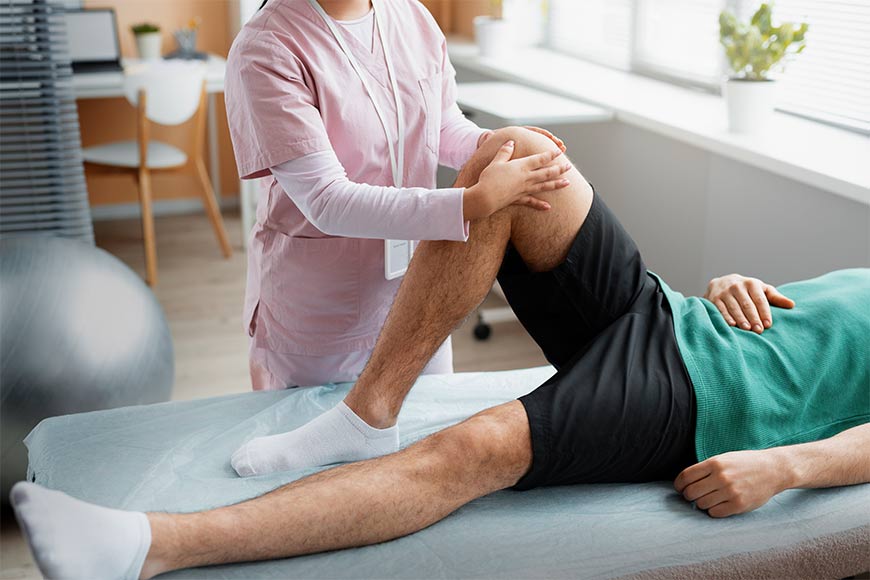
Knee rehabilitation is crucial for restoring the functionality of this important joint after injuries, surgeries, or degenerative changes. The knee is a complex joint that bears significant load during daily activities, making it susceptible to various injuries and damage. When an injury or knee problem occurs, rehabilitation is necessary to restore mobility, reduce pain, and ensure joint stability.
The goal of knee rehabilitation is to restore joint function through various therapeutic methods, prevent further loss of mobility and stability, and enable patients to return to daily activities and sports. The rehabilitation process includes techniques such as muscle strengthening exercises, stretching, manual therapy, electrotherapy, and other methods that help reduce pain, improve circulation, and increase range of motion.
Each knee rehabilitation plan must be carefully tailored to the specific needs of the patient, depending on the type of injury or condition, to achieve a faster and safer recovery. The key to successful rehabilitation is patience, consistency in applying therapy, and monitoring progress throughout the process.
Symptoms
The knee is a crucial support point that bears the weight of the entire body and enables movement, from the simplest step to complex sports activities. Due to its complex structure, consisting of bones, cartilage, ligaments, and tendons, this joint is highly susceptible to injuries and wear. We often ignore mild discomfort, thinking it will resolve on its own, but the symptoms that arise are actually precise signals from our body indicating the need for attention.
Symptoms that point to a knee problem can range from mild discomfort to sharp pain that hinders movement. The most common indicators to pay attention to are:
Knee pain (localized or radiating): Pain is the most common first alarm. It can occur during movement (especially when stepping or rotating) but also during rest or sleep, often indicating inflammatory processes. Sharp pain usually signals ligament or meniscus injury, while dull, chronic pain is often linked to degenerative changes.
Swelling and increased local temperature: The presence of swelling (fluid buildup in the joint) is a clear sign of inflammation or trauma. If the skin above the knee is red and warm to the touch, it may indicate acute inflammation or infection that requires immediate attention.
Stiffness and limited range of motion: This symptom commonly occurs in the morning, right after waking up, or after prolonged sitting. Inability to fully straighten or bend the knee suggests the presence of swelling, cartilage damage, or mechanical blockage inside the joint.
Instability and feeling of collapsing: If you feel that your knee is "giving way" or unable to support your weight, it’s likely due to ligament laxity. This feeling of instability is especially dangerous as it can lead to secondary falls and further injuries.
Auditory phenomena: creaking, popping, and snapping. While occasional painless popping is not always a cause for concern, constant creaking (crepitus) during movement or the sensation of something "catching" and "snapping" in the joint usually indicates cartilage or meniscus damage.
Functional limitations in daily life: Difficulty walking on uneven terrain, insecurity when climbing or descending stairs, and the inability to perform squats without pain are clear signs that the joint is no longer functioning properly under load.
Timely diagnosis and appropriate rehabilitation are key to preserving joint function and preventing permanent damage.
Causes
- Sports injuries
- Hormonal changes
- Modern way of life
- Overexertion syndrome
Knee rehabilitation is a complex process that requires an individualized approach to help the patient return to daily activities as quickly as possible. Physical therapy plays a crucial role in recovery, and rehabilitation is carried out in several stages:
Initial Phase: The goal is to reduce pain and inflammation, decrease swelling, and unload the joint. This phase includes therapies such as electrotherapy (TENS), ice application, and specialized exercises to reduce swelling and pain.
Middle Phase: The focus is on restoring knee mobility, stretching shortened muscles, and strengthening the thigh muscles, such as the quadriceps and hamstrings. These exercises help restore joint stability.
Final Phase: Therapy aims at stabilizing the knee through balance exercises and functional exercises like walking, squats, and stair climbing. Patients are also prepared for a return to sports activities and normal daily functions.
Physical therapy may include various methods such as kinesiotherapy (therapeutic exercises), manual therapy, electrotherapy, ultrasound therapy, therapeutic laser, and massage. The combination of these treatments helps reduce pain, improve mobility, and strengthen the muscles around the knee.
The duration of rehabilitation depends on the type and severity of the injury, typically ranging from several weeks to a few months. Consistency in therapy and cooperation with the therapist play a crucial role in the success of recovery. If therapy is started on time, a full recovery can be achieved, reducing the risk of re-injury.
Post-surgery physical therapy is a key element in the recovery process and return to normal life activities. After surgical procedures, the body undergoes a recovery phase that is often accompanied by pain, swelling, decreased mobility, and muscle weakness. Timely and properly guided physical therapy enables faster tissue healing, reduces complications, and restores full function of the operated area. The goal of therapy is not only recovery but also the prevention of further issues and long-term consequences.
FAQ
How long does the rehabilitation process take?
The duration of recovery is strictly individual and depends on the severity of the condition. Minor ligament strains can be treated in 2 to 4 weeks, while rehabilitation after an anterior cruciate ligament (ACL) surgery or hip replacement may take 6 to 9 months, or even up to a year for a full return to sports.
Is pain during exercise normal?
Pain during exercise can be normal, but it's important to differentiate between types of pain. Mild or moderate pain, such as a feeling of "tightness" or tension in the muscles during stretching or strengthening, is often part of the recovery and body strengthening process. However, sharp, stabbing pain or pain that lasts long after exercise could indicate an injury or overexertion and should be taken seriously. If you feel pain during rehabilitation exercises, it’s best to consult with your therapist to ensure the exercises are being performed correctly and that you’re not overloading your body. It's always better to take a moderate approach, progressively increasing intensity, rather than forcing exercises that could lead to injury.
Can I put weight on my leg right after an injury or surgery?
This depends solely on the instructions of the surgeon or physical therapist. For some procedures (such as meniscectomy), weight-bearing is allowed immediately, while for ligament reconstruction or meniscus stitching, full weight-bearing may be prohibited during the first few weeks to allow the tissue to heal.
What is better for the knee: ice or heat packs?
Ice (Cryotherapy): Used for acute injuries, swelling, and immediately after exercise to reduce inflammation.
Heat: Used for chronic stiffness and before exercise to relax muscles and improve circulation. Never apply ice directly to the skin; always use a towel as a barrier.
Special offer
50% discount on knee treatment package
50% discount on a knee pain treatment package at a great price of 5,000 RSD (10,000 RSD). The knee package includes:
- Physiotherapist assessment
- High-power magnetic therapy
- HILT laser
- Electrotherapy
Treat your knee pain quickly and effectively! Call us 00–24h!
Aesthetic surgery
Why choose us?
Focus Fizikal is a leading private clinic for physical therapy in Belgrade. For more than 10 years, we have been providing high-quality services that enable quick recovery and healing of our patients.




Book online
For all our current and future patients, we have made it possible to schedule an appointment online.

Contact




pon-pet:
08:00 - 20:00subota:
08:00 - 15:00Links
Partners
Partners
Pratite nas



Contact
Mon-Fri:
08:00 - 20:00Saturday:
08:00 - 15:00