 +381 64 469 73 73
  Back pain when inhaling
  Symptoms
  Causes
  Treatment
  FAQ
FAQ  Prices
  Gallery
  Testimonials
  Special offer
  Why choose us?
Cash
Through a current account

Focus Physical Therapy 100% guarantees fast and effective treatment.
SUPER DISCOUNT! 20% off all therapies in June! Call us 24/7!
Do not treat yourself based on information from the Internet!


Pain in the back during deep inhalation is a specific symptom that indicates restricted mobility in the rib cage or thoracic spine region. With each breath in, the ribs must lift and expand to allow the lungs to fill with air, which requires perfect coordination of the joints between the vertebrae and the ribs. If any of these joints are blocked or the surrounding muscles are in spasm, every attempt at deep breathing triggers a sharp sensation in the back because the irritated structure is forcibly moved.
The anatomy of the rib cage includes twelve pairs of ribs that are directly connected to twelve thoracic vertebrae. Between each rib are the intercostal muscles, which, together with the diaphragm, enable the process of ventilation. In addition to the bone and muscle structures, the pleura is also located in close proximity, a thin membrane that surrounds the lungs and is highly rich in nerve endings. Understanding the relationship between rib biomechanics and the flexibility of the thoracic spine is crucial for identifying the cause of pain that occurs during inhalation. Timely physical therapy assessment and mobilization of the rib cage help prevent chronic stiffness and shallow breathing, which can lead to overall fatigue of the organism.
Symptoms of back pain during inhalation most often manifest as a sharp "stabbing" sensation in the shoulder blade area or along the spine, which often forces patients to stop breathing mid-inhale. The pain can be localized at a single point or spread in a semi-circle toward the front of the chest, following the path of the ribs. The clinical picture is specific because the symptoms are directly related to the mechanical expansion of the lungs, while during rest or shallow breathing, the pain may be completely absent.
The most common symptoms accompanying back pain during inhalation include:
Sharp, stabbing pain between the shoulder blades that occurs exclusively during maximum inhalation or yawning.
A sense of tightness and the inability to fill the lungs completely with air, which patients describe as "shortness of breath."
Pain that intensifies during torso rotation, leaning to the side, or while coughing and sneezing.
Local sensitivity to pressure in the area of the spinal vertebrae or at the point where the ribs connect to the spine.
A dull back pain is present throughout the day that becomes sharp and shooting only during more intense breathing.
These signs are clear indicators that the rib cage is experiencing a functional limitation that requires professional evaluation and manual release. Recognizing these symptoms in time prevents the development of long-term muscle spasms that can lead to poor posture and chronic pain in the neck and shoulders.
The causes of back pain during inhalation are most commonly associated with mechanical blockages of the spinal facet joints or the costovertebral joints, where the ribs connect to the vertebrae. Factors such as sudden movements, lifting heavy objects while rotating, prolonged sitting in a slouched position, or exposure to drafts directly contribute to the onset of spasms. Although the pain originates in the back, the cause can also be inflammatory in nature, involving the pleura (lung lining) or the intercostal nerves.
The primary causes of back pain during inhalation are:
Blockage of the costovertebral joints, where a slight displacement of a rib relative to the vertebra prevents the normal expansion of the rib cage.
Intercostal neuralgia, or the irritation or inflammation of a nerve passing between the ribs, causes shooting pain with every movement of the chest.
Spasm of the rhomboid or trapezius muscles, which exert pressure on the rib cage through tension and interfere with breathing.
Pleurisy (pleuritis), occurs when friction between inflamed membranes during inhalation causes intense pain in the back or chest.
Thoracic disc herniation, which is rarer than lumbar herniation, can exert pressure on nerves that are activated during inhalation.
Precisely identifying the cause of the pain allows for the creation of an individual treatment plan that will quickly restore rib mobility and eliminate muscle tension. Each of these causes requires a specific rehabilitation approach to achieve lasting relief and the normalization of breathing.
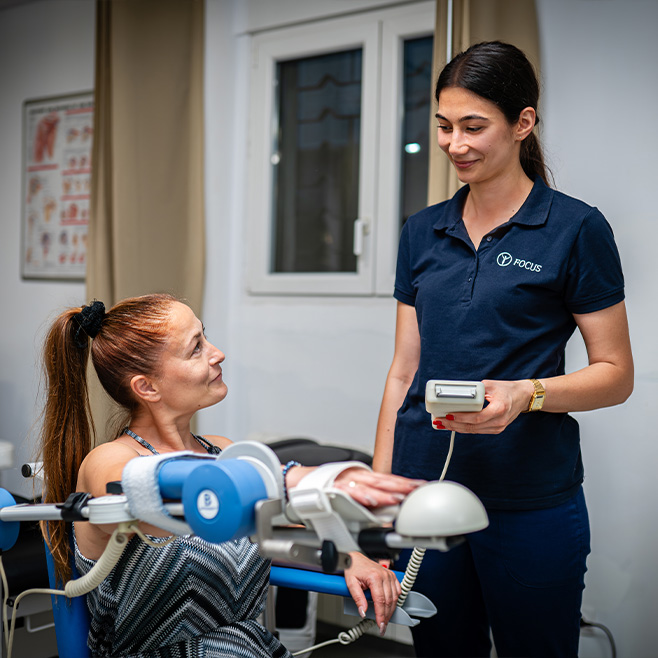
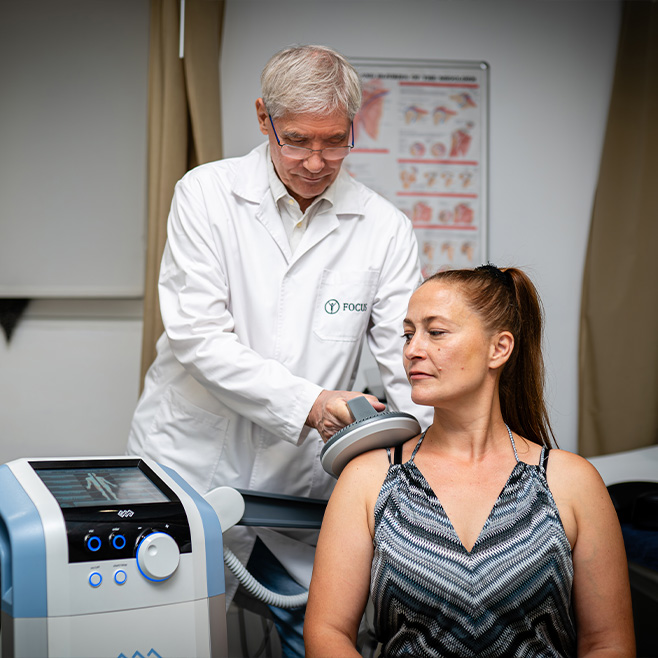
Treatment of pain in the back during inhalation at the Focus Physical Therapy Center is focused on manual unlocking of rib and spinal joints, combined with relaxation of deep back and thoracic muscles. The therapeutic protocol combines the use of advanced physical agents that penetrate deep into tissues with breathing techniques that increase chest mobility and lung capacity. Successful rehabilitation involves restoring full elasticity of all structures involved in the breathing process, thereby eliminating pain during inhalation and restoring normal function.
A modern rehabilitation approach includes the following phases:
Continuous adherence to the recommended exercise program is essential for maintaining results and preventing recurrence of rib or spinal dysfunctions. This comprehensive approach restores a sense of effortless breathing and unrestricted movement without pain.
Could back pain when breathing in be related to heart problems?
Although pain during inhalation is more often mechanical in nature (muscles and joints), chest pain always requires caution. If the pain is accompanied by suffocation, pressure in the chest or tingling in the left arm, it is necessary to rule out cardiac causes before starting physical therapy.
How long does it take to recover from a rib lock?
Recovery time is usually very short if acted upon immediately. Most patients feel significant relief already after the first treatment of manual mobilization, while three to five treatments are required for complete stabilization of the muscles.
Can massages help with this type of pain?
Classic massage can relax the superficial muscles, but it is often not enough to solve the rib joint blockage itself. For a permanent solution, professional manual mobilization is necessary to return the joint to the correct position, with the application of targeted physical therapy.
When is pain when breathing in the back a sign that an urgent X-ray is needed?
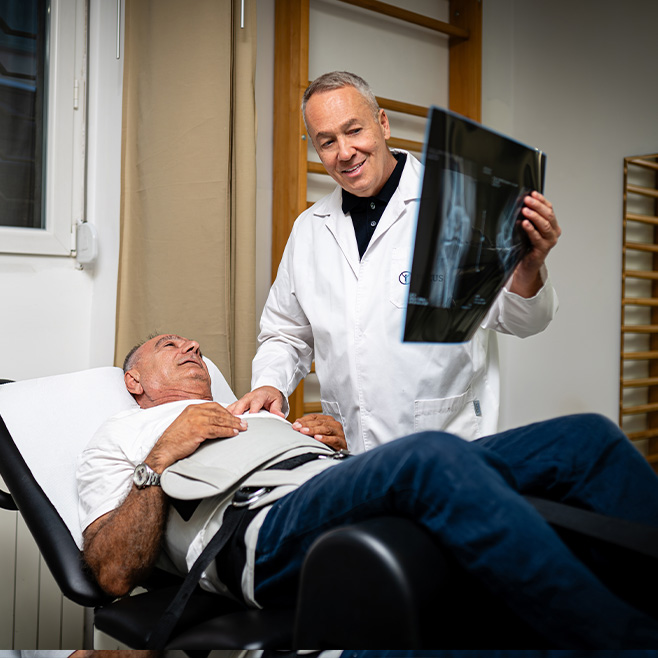
If the pain occurred after a fall, blow or traffic accident, it is necessary to take an image to rule out the possibility of a rib fracture or lung injury. Also, if the pain is accompanied by fever and cough, an X-ray is taken to check for possible pneumonia.
Why the stabbing in the back only when taking deep breaths and not when taking shallow breaths
? During shallow breathing, the chest moves minimally, so the irritated joints of the ribs and vertebrae remain in the zone that does not cause pain. A deep breath requires maximum expansion and lifting of the ribs, which puts pressure on the blocked point and activates nerve endings, causing sharp pain.
Cash
Through a current account

Aesthetic surgery
Focus Fizikal is a leading private clinic for physical therapy in Belgrade. For more than 10 years, we have been providing high-quality services that enable quick recovery and healing of our patients.




For all our current and future patients, we have made it possible to schedule an appointment online.



pon-pet:
08:00 - 20:00subota:
08:00 - 15:00


Mon-Fri:
08:00 - 20:00Saturday:
08:00 - 15:00