Luxatio, physical therapy, treatment: Focus Physiological✓

Physical therapy Belgrade | Luxatio - dislocation of the acroclavicular joint

Luxatio - dislocation of the acroclavicular joint

Luxatio - dislocation of the acroclavicular joint. TOP PRICE✓ Treatment of shoulder pain, physical therapy for the shoulder joint. Shockwave, laser, cryotherapy✓

Focus Physical Therapy 100% guarantees fast and effective treatment.

SUPER DISCOUNT! 20% off all therapies in May! Call us 24/7!

Do not treat yourself based on information from the Internet!
  • First Facility
  • First Facility
  • Treatment
  • First Facility
  • Luxatio - dislocation of the acroclavicular joint

What is Luxatio?

Luxation, or dislocation of the acromioclavicular joint, is an injury that occurs when the clavicle (collarbone) separates from the acromion, a part of the scapula (shoulder blade).

The acromioclavicular (AC) joint is a small, stable joint located at the very top of the shoulder. Its primary role is to connect the clavicle to the scapula and ensure stable transfer of load from the arm to the axial skeleton, while also allowing subtle accompanying movements of the scapula during overhead arm elevation. The stability of this joint is maintained by two groups of ligaments: the acromioclavicular ligament (which provides horizontal stability) and the much stronger coracoclavicular ligaments (the conoid and trapezoid ligaments, which maintain the vertical position of the clavicle).

At the Focus Physical Therapy Center, acromioclavicular joint injuries are approached with the highest level of clinical care. The outcome of treatment directly depends on the severity of the dislocation, which is classified according to the Tossy or Rockwood scale (Grades I to VI). While milder grades (I and II – ligament sprain and partial tearing) require only conservative physical therapy treatment, more severe grades (where complete rupture of all ligaments and visible separation of the clavicle occur) may sometimes require surgical stabilization, followed by an intensive postoperative physiotherapy protocol.

Proper rehabilitation after an AC joint dislocation at our center is focused on controlled recovery without the risk of premature loading. Through individualized treatment programs at Focus Physical Therapy Center, we successfully guide patients through all phases of soft tissue healing. Our primary goal is to eliminate pain and swelling in the acute phase through the application of targeted physical therapy modalities and then, through specific kinesitherapy exercises and strengthening of the dynamic stabilizers of the shoulder, fully compensate for the loss of passive stability caused by the injured ligaments.

Symptoms

The clinical presentation of an acromioclavicular joint dislocation develops immediately after trauma and is characterized by localized, sharp pain along with clear visual and palpable changes at the very top of the shoulder. At the Focus Physical Therapy Center, we carefully analyze these symptoms in order to determine the exact degree of instability.

The most common symptoms include:

  • Localized pain at the top of the shoulder: Intense, sharp pain strictly localized over the AC joint, which dramatically worsens with any touch or attempted arm movement.
  • “Step-off” deformity (in more severe grades):
    A visible prominence and elevation of the outer end of the clavicle relative to the shoulder contour, creating asymmetry and a noticeable cosmetic deformity of the shoulder girdle.
  • “Piano key” phenomenon: A characteristic clinical sign in which pressing the elevated clavicle downward temporarily returns it to its normal position, but it immediately rises again once the pressure is released due to rupture of the coracoclavicular ligaments.
  • Restricted movement and pain during horizontal adduction: The patient experiences severe pain when attempting to place the hand of the injured side onto the opposite shoulder (cross-body adduction test), because this movement directly compresses the injured joint.
  • Swelling and hematoma: Rapid onset of localized swelling, and depending on the extent of soft tissue and blood vessel injury, bruising may also occur and spread down along the deltoid muscle.
  • Reduced strength and inability to raise the arm: The patient instinctively protects the injured arm by holding it close to the body in a guarded position, while active elevation of the arm above shoulder level becomes impossible due to instability and pain.

At the Focus Physical Therapy Center, recognizing these signs in the early stage is a key step toward successful recovery, as it allows us to intervene promptly and prevent acute inflammation from progressing into chronic tissue damage or permanent loss of joint function.

Causes

  • Direct impacts
  • Falls
  • Traffic accidents
  • Repetitive stress

Acromioclavicular joint dislocation is primarily a mechanical, traumatic injury. It rarely occurs as a result of chronic overuse and is almost always caused by the direct application of force to the structures of the shoulder girdle. At our center, by analyzing the mechanism of injury, we accurately assess the direction of the force and the degree of involvement of the surrounding muscle attachments (the trapezius and deltoid muscles).

The main causes of AC joint dislocation include:

  • Direct fall onto the top of the shoulder (Most common cause): Falls from a bicycle, motorcycle, skis, or during contact sports, where the arm remains close to the body, and the full impact force is transferred directly onto the acromion, pushing the scapula downward while the clavicle remains fixed.
  • Fall onto an outstretched arm (Indirect trauma): Landing on the palm with the arm fully extended at the elbow and shoulder, where the impact force travels upward through the humerus to the entire shoulder girdle, resulting in shearing stress and rupture of the AC joint ligaments.
  • Traffic accidents: Direct blows to the lateral side of the torso and shoulder during car or motorcycle accidents, where high kinetic energy instantly tears the stabilizing soft tissue structures.
  • Contact and combat sports: Intense collisions and falls in football, rugby, handball, judo, or wrestling, where mechanical impacts to the shoulder are a routine part of the activity.
  • Severe occupational trauma: Falls from height (such as on construction sites) or direct impact of a heavy object onto the clavicle, causing significant mechanical separation of the joint surfaces.

Treatment

Treatment and physical therapy for acromioclavicular (AC) joint dislocation require patience and a combination of different therapeutic methods, as symptoms do not resolve overnight. The first step in conservative treatment (Grade I and II injuries) involves immobilization of the arm (using a sling or shoulder brace) for 1 to 3 weeks in order to unload the injured ligaments and allow primary healing. During this early phase, home-based cryotherapy (local ice application over the joint several times a day) is essential to control swelling and reduce sharp pain.

At the Focus Physical Therapy Center, AC joint dislocation treatment is carried out through strictly phased and controlled rehabilitation protocols that safely restore shoulder stability and function:

  • Functional diagnostics and evaluation: Clinical assessment of the degree of clavicular displacement, examination of skin integrity and neurovascular status of the arm, as well as detailed analysis of X-ray findings (often performed under load) before starting therapy.
  • HILT Laser Therapy (High-Intensity Laser Therapy): Applied from the first days after removal of immobilization or during immobilization breaks. Due to its high power, the laser penetrates deeply into the AC joint, accelerates cellular metabolism, significantly reduces inflammatory swelling, and stimulates collagen synthesis necessary for ligament repair.
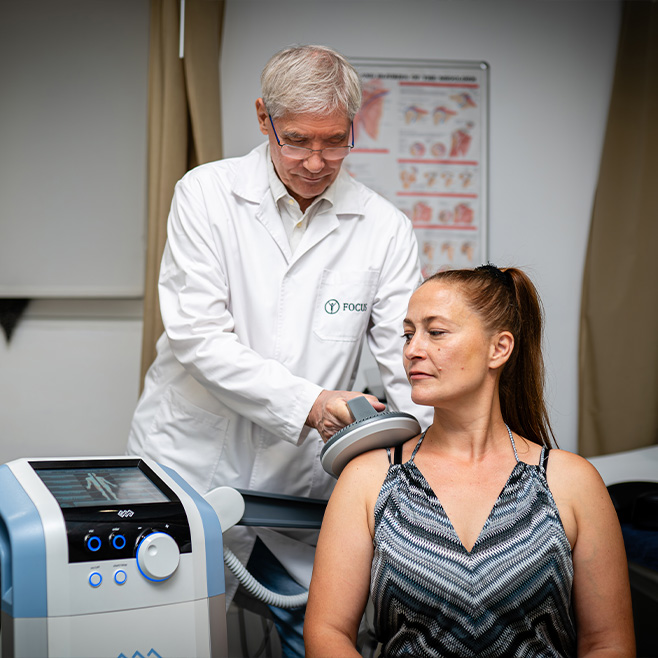
  • Tecar Therapy: A radiofrequency-based therapy used for strong thermal and biostimulatory effects. Tecar therapy relaxes secondary painful spasms of the neck and shoulder muscles (trapezius and levator scapulae), improves local microcirculation, and accelerates hematoma resorption.
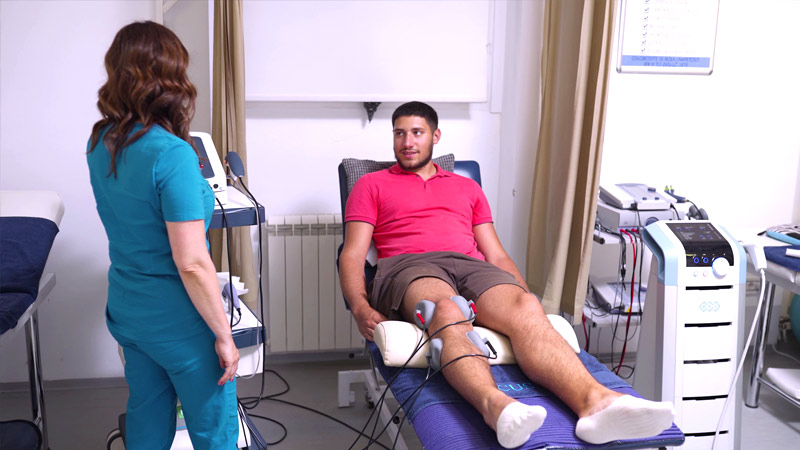
  • Electrotherapy (TENS and Interferential Currents): Targeted application to block pain signals at the spinal level, reduce acute local inflammation, and stimulate the release of endorphin-producing substances that facilitate the early initiation of exercise therapy.
  • Manual Therapy and Mobilization of Adjacent Joints: Gentle manual techniques used by the physiotherapist to maintain mobility of the glenohumeral joint, cervical spine, and scapula, preventing the development of “frozen shoulder syndrome” during immobilization.
  • Kinesiotherapy and Dynamic Stabilization: The key phase of recovery, beginning with early passive and pendulum exercises that progressively transition into active-assisted exercises. Special emphasis is placed on strengthening the deltoid and trapezius muscles, which assume the role of dynamic stabilizers and compensate for weakened ligaments.
  • Kinesio Taping and Specific Stabilization Techniques: Application of elastic therapeutic tape with high tension above the clavicle in order to mechanically “push” it downward and provide external joint stability, helping the patient safely perform exercises and daily activities.

The combination of these advanced physical therapy modalities and targeted kinesiotherapy programs at the Focus Physical Therapy Center enables maximal functional recovery, restores full range of motion and shoulder girdle strength, minimizes the risk of chronic instability, and allows a safe return to daily and sports activities.

FAQ

How long does it take to recover from an acromioclavicular joint sprain?

Recovery can last from several weeks to several months, depending on the severity of the injury and the type of treatment.

Will I be able to return to sports activities after the injury?

In most cases, with adequate treatment and rehabilitation, patients can return to sports. It is important to consult your doctor before returning to physical activity.

How can I prevent this kind of injury?

Wearing protective equipment in sports, proper fall technique and strengthening the shoulder muscles can reduce the risk of injury.

Is rehabilitation necessary after surgery?

Yes, rehabilitation is key to regaining full shoulder function after surgery.

Prices

Therapeutic day (2-3 classic physical therapy procedures and SIS or hilt with kinesi therapy)

6.500 din - 4.000 din

6.500 din - 4.000 din

Therapeutic package of 10 treatments and control examination

55.000 din - 45.000 din

55.000 din - 45.000 din

Payment

Fizikalna terapija Beograd

Cash

Fizikalna terapija Beograd

Through a current account

Testimonials

Successful treatment of patients

See the experiences of our satisfied patients who successfully recovered with the help of our physical therapy. Get acquainted with the testimonies of patients who faced various joint injuries, sports knee injuries, back injuries and similar problems, which we quickly, efficiently and successfully treated.

Aesthetic surgery

Why choose us?

Focus Fizikal is a leading private clinic for physical therapy in Belgrade. For more than 10 years, we have been providing high-quality services that enable quick recovery and healing of our patients.


Physical therapy Belgrade
Leading Serbian experts and specialists
Physical therapy Belgrade
The most advanced equipment for physical therapy
Physical therapy Belgrade
100% guarantee on all services and treatments
7
doctors and specialists
5k+
satisfied patients
15
years of work and experience
25+
patients every day
Physical therapy Belgrade | Why choose us?

Free consultations

We offer free consultations to answer all your questions.

Book online

For all our current and future patients, we have made it possible to schedule an appointment online.