Pain in the upper arm when raising the arm, physical therapy: Focus Fizikal✓

Physical therapy Belgrade | Pain in the upper arm when raising the arm

Pain in the upper arm when raising the arm

Pain in the upper arm when raising the arm, Belgrade. TOP PRICE✔ Treatment of impingement syndrome, rotator cuff, bursitis and shoulders✔ Shockwave, laser, tekar, magnetic, kinesitherapy✓

Focus Physical Therapy 100% guarantees fast and effective treatment.

SUPER DISCOUNT! 20% off all therapies in June! Call us 24/7!

Do not treat yourself based on information from the Internet!

  • First Facility
  • First Facility
  • Treatment
  • First Facility
  • Pain in the upper arm when raising the arm

Pain in the upper arm when raising the arm

The shoulder joint (glenohumeral joint) is the most mobile joint in the human body, but due to this high mobility, it is naturally less stable. The main role in its active stabilization and movement is played by the rotator cuff—a group of four muscles and their tendons (m. supraspinatus, m. infraspinatus, m. teres minor, and m. subscapularis). Above these tendons lies the bony roof of the shoulder (the acromion), and between them is a protective bursa that reduces friction. When the arm is raised, the space beneath the acromion narrows. If the tendons are inflamed or thickened, painful impingement occurs, and the pain, following nerve pathways, is referred down the upper arm, often reaching the elbow.

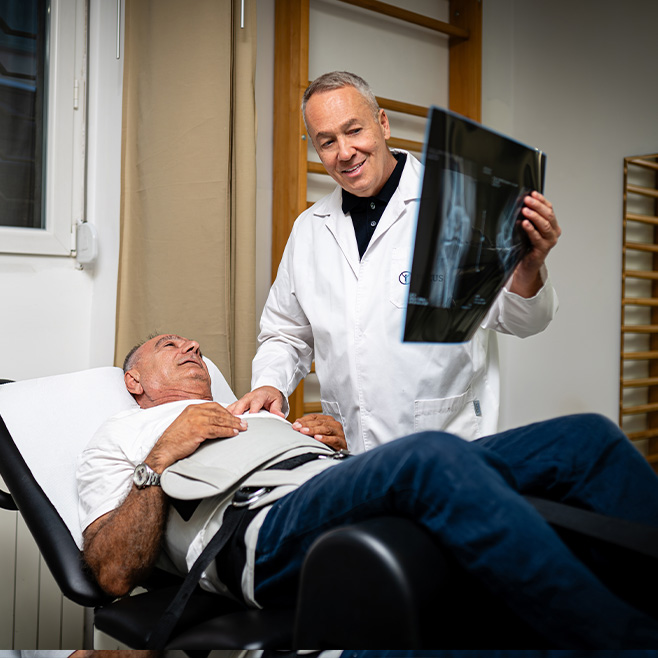
At the Focus Physical Therapy Center, we approach upper arm pain during arm elevation through a detailed biomechanical and functional assessment of the shoulder girdle. A very common misconception among patients is that the problem is located in the upper arm muscles themselves (deltoid or biceps), which is why inappropriate treatment of the arm alone often does not produce results. Our primary goal is to use specific clinical provocation tests (such as the Neer and Hawkins-Kennedy tests) to precisely determine which rotator cuff tendon is affected and whether bursitis is present, in order to design an effective and safe treatment protocol.

Proper rehabilitation of this syndrome at our center focuses on restoring the subacromial space and normal shoulder biomechanics. Through individualized programs at the Focus Physical Therapy Center, we successfully combine modern physical therapy modalities that deeply reduce inflammation with specialized manual techniques. Our ultimate goal is to eliminate the so-called “painful arc” (pain occurring between 60 and 120 degrees of arm elevation), recenter the head of the humerus within the joint socket, and restore full, pain-free arm function.

Treatment

The clinical picture of this condition develops gradually, starting with mild discomfort during specific movements and progressing to constant, sharp pain that significantly limits daily functioning. At the Focus Physical Therapy Center, we carefully analyze the type and timing of pain in order to precisely determine the stage of inflammation.

The most common symptoms include:

  • Sharp upper arm pain when raising the arm: Intense, radiating pain on the outer or front side of the upper arm, triggered by lifting the arm above shoulder level or abducting it to the side.
  • Presence of a “painful arc” (Painful Arc): A characteristic pattern where the arm is pain-free during the initial phase of lifting, then pain appears between 60 and 120 degrees of elevation, and may disappear again above this range as the tendon passes the critical impingement zone.
  • Severe night pain when lying on the affected side: Dull, throbbing pain that worsens during the night and disrupts sleep, especially when the patient unknowingly puts pressure on the shoulder joint or sleeps with the arm overhead.
  • Pain during backward arm rotation: Marked discomfort and inability to place the arm behind the back, such as when fastening a bra, putting on a belt, or reaching for a wallet in the back pocket.
  • Loss of muscle strength in the arm: Noticeable weakening of the shoulder and upper arm, making it difficult to lift even light objects (such as a bottle of water or a cup) or to keep the arm raised for extended periods (e.g., while blow-drying hair).
  • Crepitus and clicking sounds: Sensation of grinding or snapping within the shoulder during circular arm movements, indicating chronic tendon thickening or the presence of calcifications.

At the Focus Physical Therapy Center, early recognition of these signs is a key step toward successful treatment, as it allows timely intervention to prevent acute inflammation from progressing into chronic tissue damage or permanent loss of joint function.

Causes

  • Subacromial impingement syndrome
  • Rotator cuff tendinitis
  • Shoulder bursitis
  • Calcific tendinitis  

The onset of upper arm pain when raising the arm is most often the result of chronic overload and microtrauma caused by repetitive overhead movements. At our center, through biomechanical postural assessment, we identify the primary cause of shoulder space narrowing in order to prevent recurrence of symptoms.

The main causes of upper arm pain include:

  • Shoulder impingement syndrome: Mechanical friction and compression of the acromion on the supraspinatus tendon and the subacromial bursa during arm elevation, leading to chronic inflammation.
  • Rotator cuff tendinitis and tendinopathy: Inflammatory or degenerative changes in the tendons that stabilize the shoulder, most commonly caused by tissue aging, reduced vascular supply, or continuous overload.
  • Subacromial bursitis: Inflammation of the protective fluid-filled sac (bursa), which becomes swollen with excess fluid. Due to limited space under the bony roof of the shoulder, every arm elevation directly compresses the bursa and causes sharp pain.
  • Long head of the biceps tendinitis: Inflammation of the biceps tendon that runs through the front of the shoulder. When irritated, pain is referred down the front of the upper arm during flexion and lifting movements.
  • Calcific shoulder tendinitis: Deposition of calcium salts within the rotator cuff tendons. The calcification acts as a foreign body, mechanically irritating surrounding tissues and causing very intense acute pain episodes.
  • Occupational and sports overuse: Prolonged overhead work (painters, electricians, hairdressers) or participation in sports involving frequent throwing and overhead movements (tennis, volleyball, swimming, handball).

Treatment

Treatment and physical therapy of the shoulder and upper arm require patience and a combination of different methods, as symptoms do not resolve overnight. The first step in therapy is the temporary avoidance of activities that provoke sharp pain, namely, movements involving lifting the arm above shoulder level and carrying heavy loads. During the acute phase, accompanied by severe, radiating pain, cryotherapy (ice application) to the front and outer part of the shoulder is recommended several times a day for 10–15 minutes to reduce inflammation, along with strict avoidance of sleeping on the affected arm.

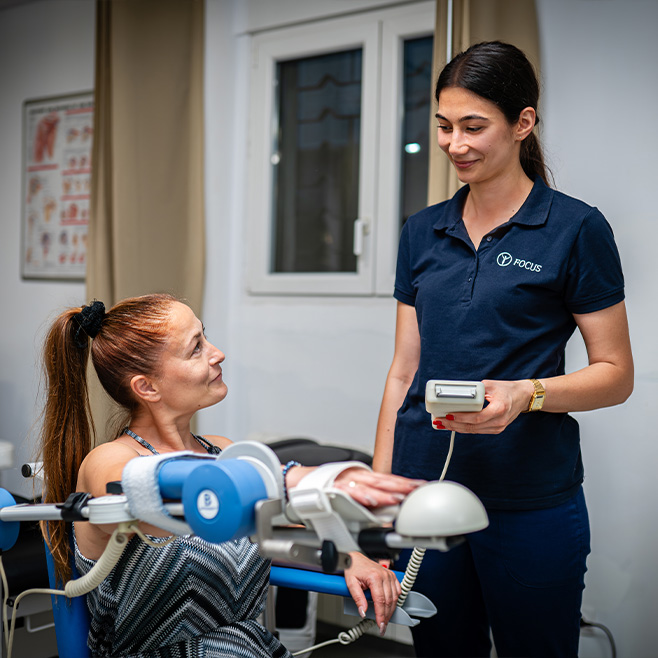
At the Focus Physical Therapy Center, treatment of this painful syndrome is carried out through strictly individualized protocols designed to safely eliminate inflammation and permanently restore the biomechanics of the entire shoulder girdle:

  • Functional diagnostics and range of motion assessment: Detailed evaluation of passive and active shoulder mobility, strength testing of individual rotator cuff muscles, and palpation of tendon insertions prior to starting therapy.
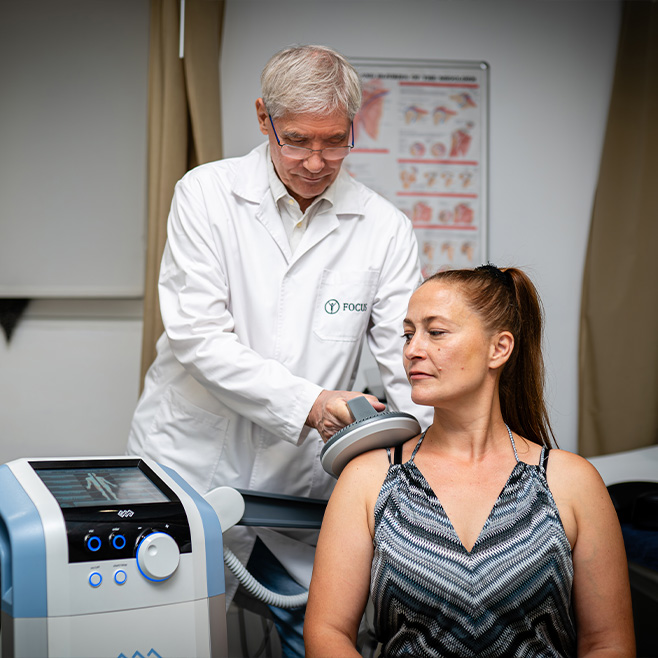
  • TECAR therapy for the shoulder: Application of high-efficiency radiofrequency energy. TECAR therapy deeply heats the internal structures of the shoulder joint, increases local circulation, immediately relaxes painful secondary muscle spasm, and stimulates the resorption of inflammatory edema.
  • HILT laser therapy (High-Intensity Laser Therapy): Penetrates deeply through the deltoid muscle directly into the subacromial space and affected tendons. It has a strong anti-inflammatory effect, rapidly reduces pain and swelling, and stimulates fast cellular regeneration of tendon tissue.
  • Electrotherapy (IFS, TENS, diadynamic currents): Application of targeted electrical currents that block pain transmission to the brain, have a muscle-relaxing effect, and locally reduce inflammation in the soft tissues of the shoulder and upper arm.
  • Manual therapy and joint mobilization: Specific manual techniques in which the physiotherapist performs gentle traction and mobilization of the glenohumeral joint and scapula. This mechanically increases the subacromial space and releases pressure on the compressed tendon.
  • Kinesiotherapy and corrective exercises: A key phase of recovery that begins with safe pendulum (relaxation) exercises and progressively advances to specific eccentric strengthening exercises for the rotator cuff and scapular stabilizers (m. serratus anterior, m. trapezius).
  • Kinesiology taping of the shoulder and upper arm: Application of special elastic tapes that gently lift the skin, reduce pressure on the subacromial bursa, support the supraspinatus muscle, and maintain proper shoulder positioning between therapy sessions.

The combination of these advanced modalities and expert manual therapy at the Focus Physical Therapy Center ensures rapid pain relief, eliminates shoulder impingement during arm elevation, and restores full freedom of movement, strength, and the ability to perform all daily and sports activities without limitation.


FAQ

What most commonly causes upper arm pain when raising the arm?

The most common cause is shoulder impingement syndrome and problems with the rotator cuff tendons.

Does upper arm pain originate from the arm muscle itself?

In most cases, no. The pain comes from the shoulder and radiates into the upper arm.

Why does my arm hurt when I raise it above shoulder level?

Because during that movement the space in the shoulder narrows, causing pressure on the tendons and bursa.

Is upper arm pain a sign of a serious problem?

It is usually not serious, but it can become chronic if not treated in time.

Which therapy helps with upper arm pain?

Physical therapy methods such as TECAR, HILT laser, electrotherapy, manual therapy, and exercises are most effective.

When should I see a physiotherapist?

When the pain lasts several days, worsens, or limits daily activities.

Payment

Fizikalna terapija Beograd

Cash

Fizikalna terapija Beograd

Through a current account

Testimonials

Successful treatment of patients

See the experiences of our satisfied patients who successfully recovered with the help of our physical therapy. Get acquainted with the testimonies of patients who faced various joint injuries, sports knee injuries, back injuries and similar problems, which we quickly, efficiently and successfully treated.

Special offer

Aesthetic surgery

Why choose us?

Focus Fizikal is a leading private clinic for physical therapy in Belgrade. For more than 10 years, we have been providing high-quality services that enable quick recovery and healing of our patients.


Physical therapy Belgrade
Leading Serbian experts and specialists
Physical therapy Belgrade
The most advanced equipment for physical therapy
Physical therapy Belgrade
100% guarantee on all services and treatments
7
doctors and specialists
5k+
satisfied patients
15
years of work and experience
25+
patients every day
Physical therapy Belgrade | Why choose us?

Free consultations

We offer free consultations to answer all your questions.

Book online

For all our current and future patients, we have made it possible to schedule an appointment online.